Scored using Graphics cards Methodology v3.0
Graphics cards Methodology v3.0
Mathematical & Unbiased Scoring
Products in this category are scored under Frontum Graphics cards Methodology v3.0: the technical score from the specifications is the base, and independent expert and video reviews (up to ±0.5 points), owner opinions (up to ±0.3) and best-of lists (up to +0.3) move it up or down.
Explore Graphics cards Methodology v3.0

GIGABYTE GeForce RTX 3070 Gaming OC Review: 117 Specs Compared

Avg. price:~$550VRAM:8 GBMemory bus width:256 bitThermal Design Power (TDP):220 W

GIGABYTE GeForce RTX 3070 Gaming OC Review: Compare 117 technical specifications, 24 expert and video reviews and 206 owner opinions to see how this product ranks in the Graphics cards category and whether it is worth buying.
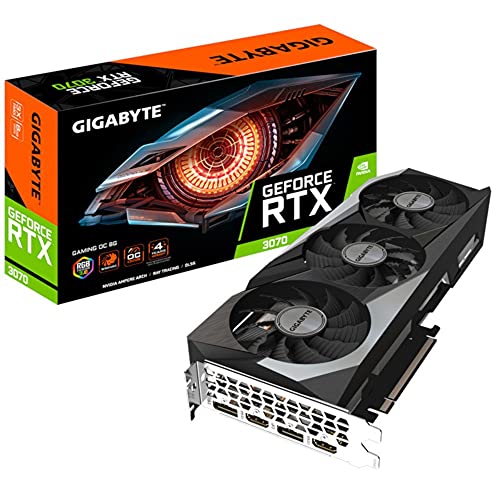
GIGABYTE GeForce RTX 3070 Gaming OC
7.3/10

Overall score

Score
7.3/ 10
✕
What it is
Our main score for this model, 1–10. It combines specs, expert reviews, best-of lists and owners.
How we count it
Parts: Technical score 40%, Reviews score 25%, List score 25%, Sentiment score 10%
Marks: Each part gets a mark out of 10. For reviews, lists and owners, a typical model in this category gets about 8 and the best one gets 10.
No data yet: A part with no data shows "?". It counts as the mark of a weaker model in this category (4 in 5 models with data score higher). This way, models with reviews, lists and owners usually come out ahead.
Score distribution
▼
<55-66-77-88-99-10
Score components

40%

6.7

Technical Score

25%

8.5

Reviews score

25%

?

List scoreNot enough data yet, so we use 7.5, the mark of a weaker model in this category

10%

6.7

Sentiment score

▲Better than 51% of graphics cards
7.4

Ratio quality/price

Ratio quality/price
7.4/ 10
✕
What it is
An indicator that combines the graphics card's overall rating with its cost.
When it matters
When you are looking for a graphics card that offers a strong balance of performance, features, and price.
Score distribution
▼
<55-66-77-88-99-10
Score components

70%

7.3

Overall score

30%

7.6

Price

▲Better than 53%
6.7

Technical Score

Technical score
6.7/ 10
✕
What it is
How good the specs are compared with the other models in this category, 1–10.
How we count it
Areas: We rate the specs in each area against the other models in this category.
Weighting: The areas that matter most to buyers count more. The shares are shown under Score components.
Share: The technical score is 40% of the overall score.
Score distribution
▼
<55-66-77-88-99-10
Score components

44%

5.9

Performance

24%

5.6

Memory

12%

8.8

Power

11%

9.2

Features

5%

8.1

Design

4%

8.5

Connectivity

▼Worse than 52%
8.5

Reviews score

Reviews score
8.5/ 10
✕
What it is
Average grade from independent test sites, magazines and video reviewers, 1–10.
How we count it
Grades: Each review's own score is converted to 1–10; without one, we grade the review ourselves. Big test sites count more, short reviews half as much as full tests. A video review counts half.
Score: The average grade is 80% of the review mark; the number of reviews is the other 20% (1 review = 5, the typical number in this category = 8, the most-reviewed model = 10).
Enough data: With few reviews, the average grade is pulled toward the typical grade of this category. No reviews yet: 7.6 for now.
Share: Reviews count 25% of the overall score.
Score distribution
▼
<55-66-77-88-99-10

80%

8.4

Average grade

20%

9.0

Popularity

Grades by review (24)
9 reviews: 4 with a printed score, 5 estimated from the review. 15 video reviews, each counting half as much as a written test. Reviews count 25% of the overall score.
User ratings collected online are not part of this score.
★Better than 91%
6.7

Sentiment score

Sentiment score
6.7/ 10
✕
What it is
How positive owners are about this model in their comments under video reviews and on forums. We read each comment, keep only people who say they own the model, and sort them into positive, mixed or negative.
How we count it
Score: We compare how satisfied this model’s owners are with the other models in this category: the typical model gets 8, the most satisfied tenth 10, the least satisfied 4. This is 80% of the owner mark; the number of owners is the other 20%.
Enough data: A model counts with 10+ owners from 4+ different discussions. With fewer, the owner part counts as 7.8 for now.
Share: Owners count 10% of the overall score (left out in categories where fewer than 10 models have enough owner comments).
Score distribution
▼
<55-66-77-88-99-10

6.7

Mark 7.2 is below the typical mark 8.2 of this category, so it cannot lift the score above the technical score

80%

7.1

Satisfaction

20%

8.0

Popularity

Owners (206)
206 owners from 19 online discussions
59% positive
11% mixed
30% negative
Category average: 73% positive
Our own analysis of online owner opinions, not a rating from any website.
▼Worse than 75%
?

List score

List score
7.5/ 10
✕
What it is
How often independent test sites, magazines and video reviewers put this model in their best-of lists for this category.
How we count it
Points: The model in the most lists of this category gets 10; the others get 8 to 10 in proportion. In no list yet: 7.5. Lists count 25% of the overall score.
Enough data: Every list counts, even a single one. With fewer than 5 best-of lists in the category, this part is left out.
Lists with this model (0)
Not in any best-of list yet, so this part counts as 7.5. Models in a list get 8 to 10.
Not in any best-of list yet
  • gigabyte-geforce-rtx-3070-gaming-oc
  • gigabyte-geforce-rtx-3070-gaming-oc
  • gigabyte-geforce-rtx-3070-gaming-oc
  • gigabyte-geforce-rtx-3070-gaming-oc
  • gigabyte-geforce-rtx-3070-gaming-oc
  • gigabyte-geforce-rtx-3070-gaming-oc
  • gigabyte-geforce-rtx-3070-gaming-oc
  • gigabyte-geforce-rtx-3070-gaming-oc
gigabyte-geforce-rtx-3070-gaming-oc
Where to Buy
*As an Amazon Associate, we earn from qualifying purchases.

What Reviewers Say About the GIGABYTE GeForce RTX 3070 Gaming OC

Based on 9 · 15

Reviewers mostly praise its cooling, performance and quiet running, while the looks, port layout and pricing draw the most criticism.
Praised
Mixed views
Criticised
Pick a topic to see who said what

What owners say about the GIGABYTE GeForce RTX 3070 Gaming OC

Based on 206 owners sharing their experience in online comments

59%positive11%mixed30%negative

Owners praise its fast gaming performance, while limited video memory and weaker high-resolution performance cause the biggest frustrations.

What owners dislike

  • Owners say the 8GB of VRAM runs out in some games and mods, causing stutter or lower settings, and worry it limits future headroom at 1440p and higher.7
  • Some owners report frame rates lower than expected in certain games, like Warzone and Apex at low settings, and a few say it barely beat their older cards.5
  • Owners say 4K at maximum settings gives only about 30 to 80 fps in demanding games, so they lower settings or accept 30 fps in some titles.4
  • Some owners report temperatures near 80 to 93 °C under heavy load, usually when fan curves are poor, and fixing fan speeds in software brings them down.4

Points mentioned by at least 3 owners, most mentioned first.

Loading...
Loading category ranking...

Technical Specifications of Graphics Card GIGABYTE GeForce RTX 3070 Gaming OC

Technical Score
Technical score
6.7/ 10
✕
What it is
How good the specs are compared with the other models in this category, 1–10.
How we count it
Areas: We rate the specs in each area against the other models in this category.
Weighting: The areas that matter most to buyers count more. The shares are shown under Score components.
Share: The technical score is 40% of the overall score.
Score distribution
▼
<55-66-77-88-99-10
Score components:

44%

5.9

Performance

24%

5.6

Memory

12%

8.8

Power

11%

9.2

Features

5%

8.1

Design

4%

8.5

Connectivity

6.7
Reviews score
8.5
Sentiment score
6.7
List score
?
Ratio quality/price
Value for money
7.4/ 10
✕
What it is
An indicator that combines the graphics card's overall rating with its cost.
When it matters
When you are looking for a graphics card that offers a strong balance of performance, features, and price.
Score distribution
▼
<55-66-77-88-99-10
Score components:

70%

7.3

Overall score

30%

7.6

Price

7.4
3DMark Time Spy benchmark score
14,328 points
This graphics card scores 14,328 points in 3DMark Time Spy, which is lower than 51.3% of graphics cards.
3DMark Port Royal score
13,886 points
This graphics card scores 13,886 points in 3DMark Port Royal, which is higher than 65.8% of graphics cards.
PassMark (G3D) result
21,358 points
This graphics card scores 21,358 points in PassMark G3D, which is lower than 56.7% of graphics cards and equal to 0.4% of graphics cards.
PassMark (DirectCompute) result
10,726 points
This graphics card scores 10,726 points in PassMark DirectCompute, which is lower than 57.7% of graphics cards.
FP32 performance
21.37 TFLOPS
This graphics card delivers 21.37 TFLOPS FP32 performance, which is lower than that of 55.4% of graphics cards and equal to that of 0.1% of graphics cards.
Show more
What reviewers say
VRAM
8 GB
This graphics card has 8 GB of VRAM, which is less than 56.8% of graphics cards and equal to 25.7% of graphics cards.
Memory type
GDDR6
This graphics card uses GDDR6 memory, which is newer than on 16.4% of graphics cards and equal to 40.3% of graphics cards.
Memory bus width
256 bit
This graphics card uses a 256 bit memory bus, which is wider than that of 50.7% of graphics cards and equal to that of 35.5% of graphics cards.
Maximum memory bandwidth
448 GB/s
This graphics card reaches 448 GB/s memory bandwidth, which is higher than that of 41.3% of graphics cards and equal to that of 11.8% of graphics cards.
Effective memory speed
14,000 MHz
This graphics card reaches an effective memory speed of 14,000 MHz, which is slower than that of 69.4% of graphics cards and equal to that of 11.1% of graphics cards.
Show more
PCI Express (PCIe) version
4
This graphics card supports PCIe 4, which is newer than on 22.5% of graphics cards and equal to 50.5% of graphics cards.
PCIe lanes
x16
This graphics card uses x16 PCIe lanes, which is more than 24.1% of graphics cards and equal to 75.9% of graphics cards.
DirectX version
12 Ultimate
This graphics card supports DirectX 12 Ultimate, which is more advanced than on 22.8% of graphics cards and equal to 77.2% of graphics cards.
Vulkan version
1.3
This graphics card supports Vulkan 1.3, which is older than on 79.2% of graphics cards and equal to 15.6% of graphics cards.
OpenGL version
4.6
This graphics card supports OpenGL 4.6, which is more advanced than on 2% of graphics cards and equal to 98% of graphics cards.
Show more
Max displays supported
4
This graphics card supports up to 4 displays, which is more than 9% of graphics cards and equal to 88.2% of graphics cards.
Max digital resolution
7680x4320
This graphics card supports a maximum digital resolution of 7680x4320, which is higher than that of 9.2% of graphics cards and equal to that of 90.9% of graphics cards.
DisplayPort outputs
2
This graphics card offers 2 DisplayPort outputs, which is fewer than 78.3% of graphics cards and equal to 9.8% of graphics cards.
DisplayPort version
1.4a
This graphics card supports DisplayPort 1.4a, which is more advanced than on 19.3% of graphics cards and equal to 46.3% of graphics cards.
DisplayPort link rates
32.4 Gbps
This graphics card supports DisplayPort link rates up to 32.4 Gbps, which is faster than on 56.6% of graphics cards and equal to 20.9% of graphics cards.
Show more
Thermal Design Power (TDP)
220 W
This graphics card has a TDP of 220 W, which is higher than that of 50.9% of graphics cards and equal to that of 4.2% of graphics cards.
Power consumption while under peak load
270 W
This graphics card draws 270 W under peak load, which is higher than 64.1% of graphics cards and equal to 0.3% of graphics cards.
Recommended PSU wattage
650 W
This graphics card recommends a 650 W PSU, which is lower than that of 39.2% of graphics cards and equal to that of 13.9% of graphics cards.
Board power limit
270 W
This graphics card has a board power limit of 270 W, which is higher than that of 62.4% of graphics cards and equal to that of 0.9% of graphics cards.
PCIe power spec
270 W
Show more
What reviewers say
Size
286x 115x 51 mm
Length
286 mm
This graphics card is 286 mm long, which is longer than 50.9% of graphics cards and equal in length to 0.3% of graphics cards.
Height
115 mm
This graphics card is 115 mm tall, which is shorter than 72.6% of graphics cards and equal in height to 1.7% of graphics cards.
Slot width
2.5 slot/s
This graphics card occupies 2.5 slot/s, which is slimmer than 35.4% of graphics cards and equal in width to 14.7% of graphics cards.
Weight
2.65 lb
This graphics card weighs 2.65 lb, which is heavier than 59.9% of Graphics cards and equal to 1.7% of Graphics cards.
Show more
What reviewers say

GIGABYTE GeForce RTX 3070 Gaming OC vs the Average Graphics Card

246810TotalPerformanceMemoryFeaturesConnectivityPowerDesign
  • 64 bit wider memory bus
    This graphics card has a wider memory bus than the average graphics card (256 bit vs 192 bit). The average graphics card has a memory bus width of 192 bit.
    256 bit vs 192 bit
  • 32 more ROPs
    This graphics card has more ROPs than the average graphics card (96 vs 64). The average graphics card has 64 ROPs.
    96 vs 64
  • 16.4% higher review score
    Reviews score
    8.5/ 10
    ✕
    What it is
    Average grade from independent test sites, magazines and video reviewers, 1–10.
    How we count it
    Grades: Each review's own score is converted to 1–10; without one, we grade the review ourselves. Big test sites count more, short reviews half as much as full tests. A video review counts half.
    Score: The average grade is 80% of the review mark; the number of reviews is the other 20% (1 review = 5, the typical number in this category = 8, the most-reviewed model = 10).
    Enough data: With few reviews, the average grade is pulled toward the typical grade of this category. No reviews yet: 7.6 for now.
    Share: Reviews count 25% of the overall score.
    Score distribution
    ▼
    <55-66-77-88-99-10

    80%

    8.4

    Average grade

    20%

    9.0

    Popularity

    Grades by review (24)
    9 reviews: 4 with a printed score, 5 estimated from the review. 15 video reviews, each counting half as much as a written test. Reviews count 25% of the overall score.
    User ratings collected online are not part of this score.
    8.5 vs 7.3
  • 10 mm lower card height
    This graphics card is shorter than the average graphics card (115 mm vs 125 mm). The average graphics card has a height of 125 mm.
    115 mm vs 125 mm
  • Supports LHR limiting
    This graphics card supports an LHR limiter, while the average graphics card does not. 7.5% of Graphics cards support one.
  • 51.8% higher ray tracing score
    This graphics card has a higher ray tracing score than the average graphics card (13,886 points vs 9,148 points). The average graphics card has a ray tracing score of 9,148 points.
    13,886 points vs 9,148 points
  • 40 more AI cores
    This graphics card has more AI cores than the average graphics card (184 vs 144). The average graphics card has 144 AI cores.
    184 vs 144
  • 6 more compute units
    This graphics card has more compute units than the average graphics card (46 vs 40). The average graphics card has 40 compute units.
    46 vs 40
  • 16.4% higher review score
    Reviews score
    8.5/ 10
    ✕
    What it is
    Average grade from independent test sites, magazines and video reviewers, 1–10.
    How we count it
    Grades: Each review's own score is converted to 1–10; without one, we grade the review ourselves. Big test sites count more, short reviews half as much as full tests. A video review counts half.
    Score: The average grade is 80% of the review mark; the number of reviews is the other 20% (1 review = 5, the typical number in this category = 8, the most-reviewed model = 10).
    Enough data: With few reviews, the average grade is pulled toward the typical grade of this category. No reviews yet: 7.6 for now.
    Share: Reviews count 25% of the overall score.
    Score distribution
    ▼
    <55-66-77-88-99-10

    80%

    8.4

    Average grade

    20%

    9.0

    Popularity

    Grades by review (24)
    9 reviews: 4 with a printed score, 5 estimated from the review. 15 video reviews, each counting half as much as a written test. Reviews count 25% of the overall score.
    User ratings collected online are not part of this score.
    8.5 vs 7.3
  • 32 more ROPs
    This graphics card has more ROPs than the average graphics card (96 vs 64). The average graphics card has 64 ROPs.
    96 vs 64
  • 40 more AI cores
    This graphics card has more AI cores than the average graphics card (184 vs 144). The average graphics card has 144 AI cores.
    184 vs 144
  • 51.8% higher ray tracing score
    This graphics card has a higher ray tracing score than the average graphics card (13,886 points vs 9,148 points). The average graphics card has a ray tracing score of 9,148 points.
    13,886 points vs 9,148 points
  • 6 more compute units
    This graphics card has more compute units than the average graphics card (46 vs 40). The average graphics card has 40 compute units.
    46 vs 40
  • 64 bit wider memory bus
    This graphics card has a wider memory bus than the average graphics card (256 bit vs 192 bit). The average graphics card has a memory bus width of 192 bit.
    256 bit vs 192 bit
  • Supports LHR limiting
    This graphics card supports an LHR limiter, while the average graphics card does not. 7.5% of Graphics cards support one.
  • 10 mm lower card height
    This graphics card is shorter than the average graphics card (115 mm vs 125 mm). The average graphics card has a height of 125 mm.
    115 mm vs 125 mm
  • 27.5% lower boost clock speed
    This graphics card has a lower boost GPU clock than the average graphics card (1,815 MHz vs 2,505 MHz). The average graphics card has a boost GPU clock of 2,505 MHz.
    1,815 MHz vs 2,505 MHz
  • Less advanced frame generation
    This graphics card has less advanced frame generation than the average graphics card (no vs multi frame generation).
  • 4 GB less VRAM
    This graphics card has fewer VRAM than the average graphics card (8 GB vs 12 GB). The average graphics card has 12 GB VRAM.
    8 GB vs 12 GB
  • 60% larger process node
    This graphics card uses a larger manufacturing process than the average graphics card (8 nm vs 5 nm). The average graphics card uses a manufacturing process of 5 nm.
    8 nm vs 5 nm
  • 21.9% lower base clock speed
    This graphics card has a lower base GPU clock than the average graphics card (1,500 MHz vs 1920 MHz). The average graphics card has a base GPU clock of 1920 MHz.
    1,500 MHz vs 1,920 MHz
  • 26.3% slower memory speed
    This graphics card has a lower effective memory speed than the average graphics card (14,000 MHz vs 19,000 MHz). The average graphics card reaches an effective memory speed of 19,000 MHz.
    14,000 MHz vs 19,000 MHz
  • No AV1 encoding
    This graphics card does not support AV1 encoding, the average graphics card does.
  • 1 fewer DisplayPort outputs
    This graphics card has fewer DisplayPort outputs than the average graphics card (2 vs 3). The average graphics card has 3 DisplayPort outputs.
    2 vs 3
  • 13.0% lower sentiment score
    Sentiment score
    6.7/ 10
    ✕
    What it is
    How positive owners are about this model in their comments under video reviews and on forums. We read each comment, keep only people who say they own the model, and sort them into positive, mixed or negative.
    How we count it
    Score: We compare how satisfied this model’s owners are with the other models in this category: the typical model gets 8, the most satisfied tenth 10, the least satisfied 4. This is 80% of the owner mark; the number of owners is the other 20%.
    Enough data: A model counts with 10+ owners from 4+ different discussions. With fewer, the owner part counts as 7.8 for now.
    Share: Owners count 10% of the overall score (left out in categories where fewer than 10 models have enough owner comments).
    Score distribution
    ▼
    <55-66-77-88-99-10

    6.7

    Mark 7.2 is below the typical mark 8.2 of this category, so it cannot lift the score above the technical score

    80%

    7.1

    Satisfaction

    20%

    8.0

    Popularity

    Owners (206)
    206 owners from 19 online discussions
    59% positive
    11% mixed
    30% negative
    Category average: 73% positive
    Our own analysis of online owner opinions, not a rating from any website.
    6.7 vs 7.7
  • 27.5% lower boost clock speed
    This graphics card has a lower boost GPU clock than the average graphics card (1,815 MHz vs 2,505 MHz). The average graphics card has a boost GPU clock of 2,505 MHz.
    1,815 MHz vs 2,505 MHz
  • 21.9% lower base clock speed
    This graphics card has a lower base GPU clock than the average graphics card (1,500 MHz vs 1920 MHz). The average graphics card has a base GPU clock of 1920 MHz.
    1,500 MHz vs 1,920 MHz
  • 16% lower texture rate
    This graphics card has a lower texture rate than the average graphics card (317.4 GTexel/s vs 378 GTexel/s). The average graphics card has a texture rate of 378 GTexel/s.
    317.4 GTexel/s vs 378 GTexel/s
  • 3 years older
    This graphics card was released earlier than the average graphics card (2020 vs 2023).
    October 2020
    2,020 vs 2,023
  • 4 GB less VRAM
    This graphics card has fewer VRAM than the average graphics card (8 GB vs 12 GB). The average graphics card has 12 GB VRAM.
    8 GB vs 12 GB
  • 26.3% slower memory speed
    This graphics card has a lower effective memory speed than the average graphics card (14,000 MHz vs 19,000 MHz). The average graphics card reaches an effective memory speed of 19,000 MHz.
    14,000 MHz vs 19,000 MHz
  • 83.3% smaller L2 cache
    This graphics card has fewer L2 cache than the average graphics card (4 MB vs 24 MB). The average graphics card has 24 MB L2 cache.
    4 MB vs 24 MB
  • Less advanced frame generation
    This graphics card has less advanced frame generation than the average graphics card (no vs multi frame generation).
  • 60% larger process node
    This graphics card uses a larger manufacturing process than the average graphics card (8 nm vs 5 nm). The average graphics card uses a manufacturing process of 5 nm.
    8 nm vs 5 nm
  • Older Vulkan version
    This graphics card supports an older Vulkan version than the average graphics card (1.3 vs 1.4).
    1.3 vs 1.4
  • 33.3% larger GPU die
    This graphics card has a higher GPU die size than the average graphics card (392 mm² vs 294 mm²). The average graphics card has a GPU die size of 294 mm².
    392 mm² vs 294 mm²
  • Older FSR version
    This graphics card supports an older FSR version than the average graphics card (3 vs 3.1).
    3.0 vs 3.1
  • No AV1 encoding
    This graphics card does not support AV1 encoding, the average graphics card does.
  • 1 fewer DisplayPort outputs
    This graphics card has fewer DisplayPort outputs than the average graphics card (2 vs 3). The average graphics card has 3 DisplayPort outputs.
    2 vs 3
  • Older HDMI version
    This graphics card supports an older HDMI version than the average graphics card (2.1 vs 2.1a).
    2.1 vs 2.1a
  • More basic codec support
    This graphics card encodes more basic formats than the average graphics card (H.264/H.265/VP9 vs H.264/H.265/AV1/VP9).
    H.264/H.265/VP9 vs H.264/H.265/AV1/VP9
  • 2 fewer monitors per output type
    This graphics card supports fewer monitors per output type than the average graphics card (1 vs 3). The average graphics card supports 3 monitors per output type.
    1 vs 3
  • Older NVDEC generation
    This graphics card has a lower NVDEC generation than the average graphics card (5 vs 6). The average graphics card offers NVDEC generation 6.
    5 vs 6
  • 10 °C lower thermal ceiling
    This graphics card has a lower thermal ceiling than the average graphics card (105 °C vs 95 °C). The average graphics card has a thermal ceiling of 95 °C.
    105 °C vs 95 °C
  • 22.7% higher board power limit
    This graphics card has a higher board power limit than the average graphics card (270 W vs 220 W). The average graphics card has a board power limit of 220 W.
    270 W vs 220 W
  • 8 °C higher idle temperature
    This graphics card has a higher idle temperature than the average graphics card (45 °C vs 37 °C). The average graphics card has an idle temperature of 37 °C.
    45 °C vs 37 °C

Video Reviews

Hands-on testing, unboxing, and real-world video evaluations

5.0
Top3Entertainment
≈ estimated
14/01/2023
Hands-on review · benchmarks, comparisons and temperature tests
Verdict
GIGABYTE GeForce RTX 3070 Gaming OC is not bad, but we cannot specifically recommend it; a Founders Edition or cheaper card is the better pick.
7.0
Attic PC Guy
≈ estimated
29/08/2021
Unboxing and review · reboot troubleshooting and benchmarks
Verdict
GIGABYTE GeForce RTX 3070 Gaming OC is recommended only with caution: if reboots persist, return it and try another brand or model.
8.0
The Tech Tank
≈ estimated
01/02/2021
Hands-on review · performance, temperatures and noise tests
Verdict
GIGABYTE GeForce RTX 3070 Gaming OC is a solid mid-range card with fair value, but it runs loud and offers no standout looks or cooling.
8.0
Hardware Mana
≈ estimated
10/01/2021
Hands-on review · cooling, noise and overclocking tests
Verdict
GIGABYTE GeForce RTX 3070 Gaming OC is an easy recommendation at a good price, though the connector design raises reliability doubts.
8.0
Tech With Sean
≈ estimated
27/11/2020
Hands-on review · benchmarks, overclocking and coil whine tests
Verdict
GIGABYTE GeForce RTX 3070 Gaming OC is a good 1440p card that runs cooler and clocks higher, but its price premium is debatable.
9.0
KitGuruTech
≈ estimated
02/11/2020
Hands-on review · 1440p benchmarks, thermals and overclocking
Verdict
GIGABYTE GeForce RTX 3070 Gaming OC is very solid, though its gains over rivals are small.
9.5
We Do Tech
≈ estimated
29/10/2020
Hands-on review · benchmarks, temperatures and noise tests
Verdict
GIGABYTE GeForce RTX 3070 Gaming OC offers the best value in the 3070 class and gets a clear recommendation for 1440p gaming.
9.0
Vortez
≈ estimated
29/10/2020
Hands-on review · side-by-side benchmarks and temperature tests
Verdict
GIGABYTE GeForce RTX 3070 Gaming OC is basic but quiet and well cooled, priced near MSRP, so we definitely recommend it.
8.0
Tech Critter
≈ estimated
29/10/2020
Hands-on review · thermal testing and performance comparison
Verdict
GIGABYTE GeForce RTX 3070 Gaming OC is a decent choice for strong performance on a budget, with a sensible power supply recommendation.
8.0
Gear Seekers
≈ estimated
29/10/2020
Hands-on review · Windows and Linux tests, noise and design
Verdict
GIGABYTE GeForce RTX 3070 Gaming OC is a quiet, compact partner card, but its price and a bent power connector pin leave the buying decision open.
9.0
Leizerg
≈ estimated
06/11/2020
Unboxing · first impressions and quick performance check
Verdict
GIGABYTE GeForce RTX 3070 Gaming OC is a very good choice for budget buyers, though coil whine and lower performance than the RTX 3080 are drawbacks.
Not graded

Expert Reviews

In-depth analysis and verdict from leading tech publications

10
techpowerup.com
✓ explicit
5/10/2022
Full review · Factory overclock
Verdict
The Gigabyte RTX 3070 Gaming OC is a factory-overclocked RTX 3070 with a large triple-fan cooler rated well beyond its 220 W, suited to buyers who want extra speed.
9.0
kitguru.net
✓ explicit
4/11/2020
Full review · Higher power limit
Verdict
The Gigabyte RTX 3070 Gaming OC is a dual-BIOS RTX 3070 with a 270 W power limit, suited to buyers who want more headroom than the Founders Edition offers.
9.5
overclock3d.net
≈ estimated
5/10/2022
Lab review · Triple-fan cooler
Verdict
The Gigabyte RTX 3070 Gaming OC is a quiet, cool-running RTX 3070 that averages just under 2 GHz, a strong pick for gamers who value performance over looks.
9.0
vortez.net
≈ estimated
5/10/2022
Full review · Triple-fan cooling
Verdict
The Gigabyte RTX 3070 Gaming OC is a factory-overclocked RTX 3070 with a 1815 MHz boost, suited to builders who have a large case and a 650 W power supply.
9.0
thetechrevolutionist.com
≈ estimated
3/11/2020
Full review · Power and cooling
Verdict
The Gigabyte RTX 3070 Gaming OC stays quiet at idle and reaches 4K above 60 FPS in most games, though it draws 390 W from the wall under load.
9.0
kitguru.net
✓ explicit
4/11/2020
Full review · Understated design
Verdict
The Gigabyte RTX 3070 Gaming OC is an understated card with a short height and full metal backplate, suited to narrow cases.
7.0
hardwarecooking.fr
≈ estimated
5/10/2022
Lab test · Triple-fan card
Verdict
The Gigabyte RTX 3070 Gaming OC is a quiet, well-cooled card with a four-year warranty, though its thin plastic shell makes it feel entry-level.
9.0
profesionalreview.com
✓ explicit
5/10/2022
Hands-on test · Triple-fan cooler
Verdict
The Gigabyte RTX 3070 Gaming OC is a compact card with a higher overclock and quiet fans, suited to buyers who want more RTX 3070 speed in a smaller case.
8.0
techtesters.eu
≈ estimated
5/10/2022
Review · Mid-size PC card
Verdict
The Gigabyte GeForce RTX 3070 Gaming OC is a solid 1440p card with dual BIOS and a shorter body for mid-size PCs, though rival coolers run more efficiently.

Third-Party Reviews

What Customers Like About GIGABYTE GeForce RTX 3070 Gaming OC

  • High gaming performance, especially for 1440p ultra settings
  • Excellent triple-fan Windforce 3X cooling system that keeps temperatures low (often below 70°C)
  • Dual BIOS feature allowing users to switch between OC and Silent modes
  • Quiet operation even under heavy load
  • Solid build quality including a protective metal backplate
  • Clean, color-neutral aesthetic with subtle RGB lighting

What Customers Don't Like About GIGABYTE GeForce RTX 3070 Gaming OC

  • Gigabyte's RGB Fusion software is frequently reported as buggy or unstable
  • 8GB of VRAM may be a limiting factor for the most demanding 4K titles
  • Mixed feedback on value for money due to inconsistent pricing and low stock
  • Large card size (2.5 slot design) may require a larger case for optimal airflow
  • Some reports of flimsy build or early failure in a small number of units

Verdict

The Gigabyte GeForce RTX 3070 Gaming OC is a performance-oriented graphics card featuring 5,888 CUDA cores and 8GB of GDDR6 VRAM on a 256-bit memory bus. It comes factory overclocked with a boost clock of 1815 MHz, significantly higher than the reference 1725 MHz, and utilizes a triple-fan Windforce 3X cooling system with alternate spinning fans for efficient heat dissipation. Main pros include its Dual BIOS (OC/Silent) functionality, excellent 1440p gaming performance, and a robust physical build with two HDMI 2.1 ports for versatile connectivity. Some cons noted by users include its larger 2.5-slot footprint that may not fit in all compact cases, and a relatively high MSRP compared to the Founders Edition at launch.

Compare GIGABYTE GeForce RTX 3070 Gaming OC With Other Products in the Graphics Cards Category

1Product to compare no. 1
VS
2Product to compare no. 2
VS
3Product to compare no. 3 (optional)

Graphic Comparison of GIGABYTE GeForce RTX 3070 Gaming OC and Other Products in the Graphics Cards Category

No results found